



Declutter with Intention:The Brain-Friendly Approach to Letting Go of What Doesn't Serve You
Why "Getting Rid of Everything" Isn't the Answer
Let's be honest: I've heard every organizing rule in the book, and they all promise the same thing. That if you just follow this one method, everything will fall into place and you'll never have to organize again.
But the whole "there's one right way to organize" mentality feels like a personal attack if you're neurodivergent, a parent, or anyone navigating real life. Because it's not about whether organizing matters; it's about pretending one approach works for everyone. News flash: It doesn't.
I get it. You've tried the whole "purge your entire wardrobe in one weekend" thing. You watched the all the popular home organizing shows. You felt motivated. And then... reality hit. Decision fatigue set in. By hour three, you were sitting on your bedroom floor with four different piles, having an existential crisis about your brand new workout gear you've never even used, wondering if maybe you should keep it "just in case."
Sound familiar?
Here's the good news: From now on, we are finally get rid of that all-or-nothing decluttering system. No more tearing your entire kitchen apart and leaving yourself even more overwhelmed than you were before. No more tossing out everything you own only to feel the regret 2 days later. No more cookie-cutter organizing systems meant for the neurotypical while ignoring those of us that don't share the same brain. That approach might work for some people, but for those of us living in a fast-paced world juggling competing demands, we need a different strategy. And the alternative? It's so much more freeing.
What Actually Is Intentional Decluttering? (And Why It Doesn't Suck)
Okay, forget everything you know about decluttering and start fresh.
Intentional decluttering is when you make conscious, deliberate choices about what stays in your home without the shame, the deadline, or the pressure to live like a minimalist.
It's asking yourself real questions:
What purpose is this serving me?
Am I keeping this out of guilt or obligation? (Be honest.)
If I saw this in a store today, would I buy this again?
Do I use this on a regular basis?
Do I have space for this?
The thing to remember is you're not trying to get rid of as much stuff as possible. You're trying to be intentional about what stays.
That's it. That's the whole thing. And it can be transformational.
Why Your Neurodivergent Brain Is Actually Perfect at This (Yeah, Really)
Here's what nobody tells you: traditional organizing methods are basically designed to fail for ADHD, autism, and other neurodivergent brains. It's not that they're a flawed system, they're not designed for the way all brains actually work.
These traditional systems are built on neurotypical decision-making, linear processing, and motivation that simply doesn't match how ADHD, autistic or neurodivergent-adjacent minds operate.
"Just sort your entire bedroom in just one day!" they say.
Meanwhile, you're staring at 47 decisions and your brain has already hit its capacity at decision #3.

Intentional decluttering? It's built differently. It gives you permission to:
Move at your own pace (no arbitrary deadlines)
Make decisions without the burnout
Keep things that are useful to YOU, even if others wouldn't approve
Take breaks without feeling like a failure
Create systems that work for your specific brand of chaos
Plot twist: Research says clutter literally increases cortisol (your stress hormone) and contributes to anxiety. So when you declutter intentionally without the overwhelm—you're not just tidying your home. You're investing in your mental health. I don't know about you, but that's the kind of self-care I can definitely get behind.
Ready to get practical? The good news is that you don't need a complicated system. You need a simple one that works for your brain.
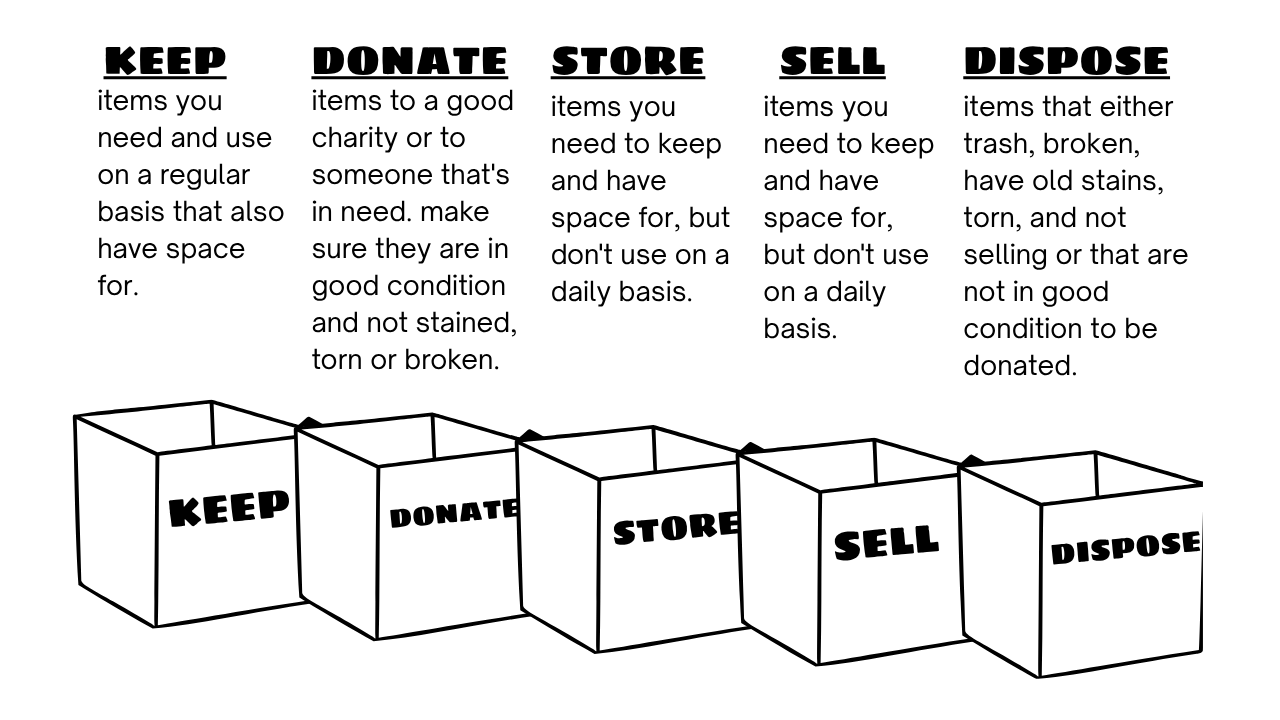
The foundation of intentional decluttering is making mindful choices about what stays and what goes without the overwhelm. If you're looking for a specific, step-by-step method to walk you through the process, I've got you covered..
Check out my article The 5 Box Decluttering Method for a detailed, brain-friendly approach that makes the whole process manageable. It breaks down exactly how to sort, decide, and move items intentionally without the decision fatigue..
In the meantime, here are the brain-hacks that work no matter which method you choose:
The Brain-Hacks That Actually Work
Soundtrack your way through it: Music or an audiobook = dopamine + distraction from decision fatigue. Suddenly three hours flew by and you actually finished something.M
Make it visual: Use colorful labels or bins for your five boxes from The 5 Box Decluttering Method. You could even assign a color to each box/bin if you wanted to. The labels are really the most important part of this system to keep your items sorted as you work through your decluttering zone of choice.
Get an accountability partners: Text a friend your before/after pics. Tell your family what you're doing. External motivation is powerful, especially for neurodivergent brains.
Take pics of sentimental items before letting them go: Keep the things from loved ones or special moments in your life that mean alot to you. While releasing the weight of the past, If you're worried you'll regret getting rid of something, photograph it first. Save the memory, not the clutter.
Keep in Mind: Good enough" is the goal: Your space doesn't need to look Instagram-worthy. This isn't about having the "perfect" aesthetics, it just needs to work for you and your unique way of living.
The Mindset Shift That Changes Everything
Stop trying to have the least amount of stuff.
Start trying to have the right amount of stuff for your life.
That might mean:
Holding onto that box of childhood memories.
Keeping 20 books instead of 5, but still letting some go.
Not donating your seasonal hobby supplies even though you only use them twice a year. As long as you're still using them, you can keep them.
Having three black t-shirts instead of one "capsule wardrobe" shirt. Those t-shirts can still be worn as long as they're in good condition
All of this is okay. You're not competing in a minimalism Olympics. You're building a home that's designed around you and made to work for you.
The Transformation: Once You Start, It Keeps Going
Here's what happens after you declutter a few small spaces intentionally:
You become aware.
Suddenly, when you're about to buy something new, you ask: "Do I actually need this? Will it fit my life? Is this aligned with how I want to live?"
You'll stop bringing random stuff into your home and falling into the trap of overconsumption just because it was on sale. You'll second guess that beauty product you're favorite influencer is so obsessed with on TikTok that they promise will be "life-changing".
You'll find yourself becoming more intentional. Not in a rigid, boring kind of way, but in a way that feels good. Like you're actually taking the time to pause and think about what actually matters to you. Instead of trying force yourself into box that God didn't intent for you to live in.
Let me be clear. This isn't selfishness, it's self-respect. This is taking back your home, your mental health and living with intention.
Real Talk: This Isn't a One-Time Thing
Life changes. You change. Your needs change. And that's beautiful.
Intentional decluttering isn't a project you "complete" and then you're done forever. It's a practice. A way of relating to your stuff and your space with curiosity and compassion instead of shame.
Some seasons you'll need to let go of more. Other seasons you'll keep things that past-you would've tossed. Both are valid.
Give yourself grace. Your home doesn't need to be perfect. It needs to work for you. And that's enough.
Your Next Move
Pick one small space this week. Whether that's a drawer. A shelf. the top of a dresser. Just begin with something small.
Give yourself about 15 minutes and label 5 Boxes that are mentioned in my '5 Box Decluttering Method' KEEP, DONATE, STORE, SELL and DISPOSE. Ask yourself the questions I have listed earlier in the section What Actually Is Intentional Decluttering? (And Why It Doesn't Suck) as you work your way through the process.
You don't have to turn your bedroom upside down. You just need one zone. That's it. And once you start seeing those small wins, you'll want to keep going.
Just by being here, you're already ahead of the game. You know something needs to change, and you're ready for it. That's the real win.
Ready to get started? Here are some products I recommend to support your intentional decluttering and organizing journey:
Neon Colorful Index Cards (to label your boxes/bins with)
Pastel Colorful Index Cards (to label your boxes/bins with)
Peel & Stick Label Holders (to go with index card labels)
What's one small space you'd declutter if you knew it wouldn't stress you out? Drop it in the comments—I want to hear what you're working on!
YOU MIGHT ALSO LIKE
Created with ©systeme.io